The Psychology of Almost There
By Siofra Timmins, 18 September 2026
The Sydney Marathon was last month, and as I tracked my friends getting over the finish line, one thing was constant, they all sped up for that last few hundred metres. That has happened to me too, and it is actually a psychological pattern called the goal gradient effect, the psychology of almost there. And it doesn't just happen in running!
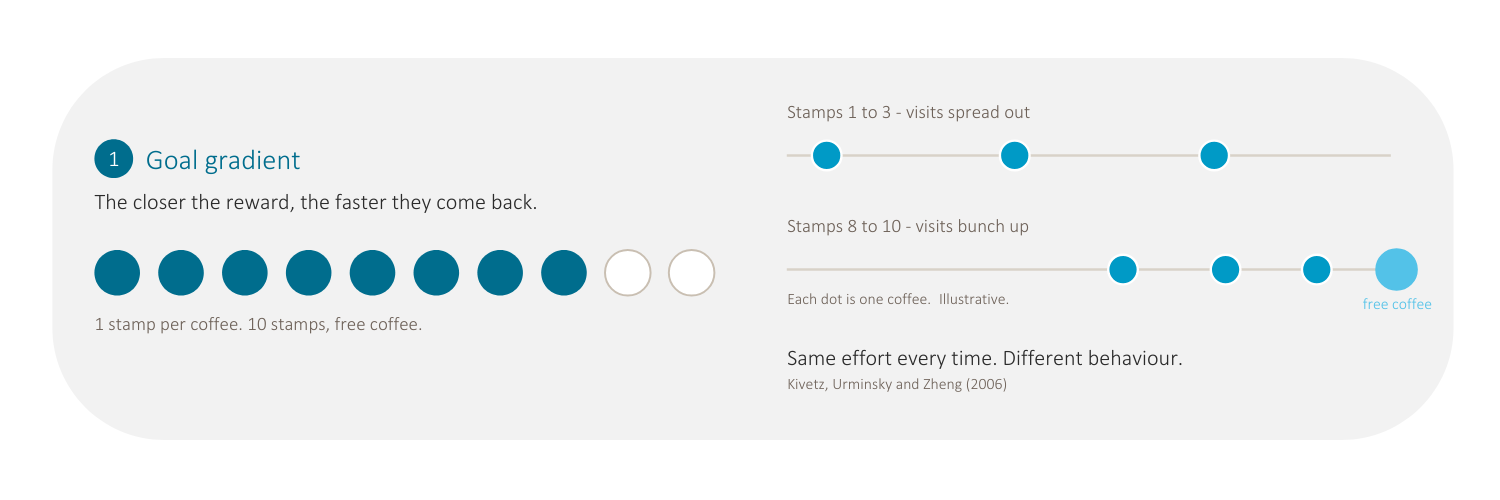
From a consumer behaviour perspective, think of a coffee stamp card. Research has shown that the inter-purchase interval (the time between purchases), gets noticeably shorter as the card fills up, so someone with one stamp left comes back faster than someone with four left. Getting from one stamp to two takes exactly the same effort as getting from four to five, but we behave differently.
The goal gradient effect, originally from Clark Hull1 in 1932, states that the tendency to approach a goal increases with proximity to the goal. Hull tested this on rats, who ran progressively faster as they got closer to food, demonstrating their increasing motivation as they got visibly closer to the goal.
Applying this to loyalty
This is very relevant in loyalty program design, because we are designing rewards that customers need to care about enough that they register as a goal, and then we need to show them how close they are. It's the reason so many programs take inspiration from the coffee stamp card, showing a visible countdown to something worth having, like Starbucks (stars), 7-Eleven (7th visit reward) and even Mecca (progress toward your next Beauty Loop level).
So when you're designing, there are some things to consider:
Make sure the reward is worth the effort, or the goal gradient effect won’t apply.
Design visible progress, because the motivational boost is stronger when the goal is easy to picture (Cheema and Bagchi, 20112)
Watch the gap between thresholds, because a program with one distant reward and nothing in between leaves most of its members permanently far from the finish line (That's why Starbucks US added a 60 Star reward worth $2 off any item when it overhauled its March 2026, saying members had asked for faster access to rewards3).
Your barista might not be flirting with you when they give you two stamps on your first visit
This is where the goal gradient effect crosses over with another interesting psychological phenomenon, the endowed progress effect.
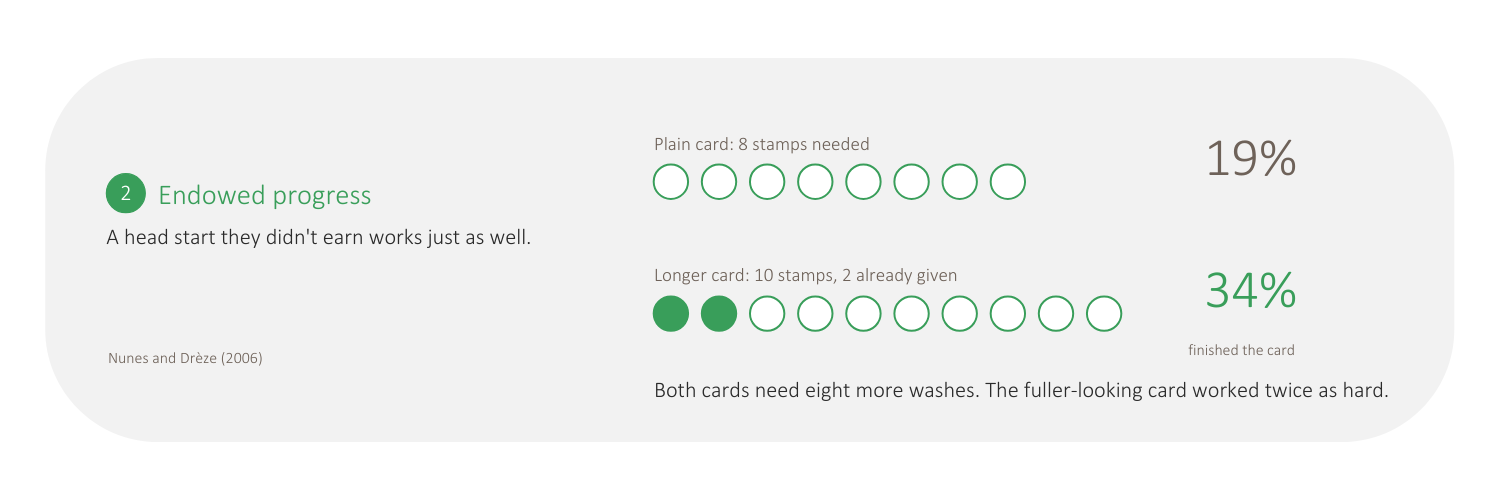
The research found that a head start people haven't earned (i.e. artificial progress) still works, and makes people even more likely to have the motivation to complete the task. The study used car wash cards, where one group received a standard card requiring eight stamps for a free wash, and a second group received a card requiring ten stamps but with two of them already stamped. Both groups needed the same eight further washes to earn the reward, and the card that looked further along worked considerably harder. Around 34% of those customers completed it, against around 19% on the plain eight-stamp card4.
In loyalty program design, this means considering a small, honest head start at sign-up, like a few points already loaded, or a tier partly earned through something the member has already done. Woolworths did this with its September 2026 container credits promotion, where members who downloaded the Everyday Rewards app received five bonus credits. The head start is doing two jobs, getting the app installed, and putting the member partway along a collection they now feel invested in finishing.
So maybe your local barista has been told to start everyone off with two stamps.
Another example in action – collectables
The effect is strongest when the goal is finite and you can see the whole thing. Disney Ooshies is the clearest recent Australian evidence. Woolworths reported total Australian food sales up 7.6% in the first eight weeks of 2026/27 and attributed roughly 1.5 to 2 points of that growth to the campaign. A collectible makes the gap between where you are and where you want to be physically visible and finite.
Things to watch out for
The reset. Once a goal is reached the member starts again, and the ones who sprinted hardest tend to drop off the most. The next goal has to already be in view. That’s one of the reasons that points and tiers work well together, because once you've made a points redemption you're still working towards your tier.
Too many small pieces. The effect weakens when a single reward is broken into sub-goals (Cheema and Bagchi, 2011). Cashback is where you see this most clearly. Every transaction pays out a little, so nothing builds and there is never a point where you are almost there. That is fine if you want members to spend more across the board. It is the wrong mechanic if you want them to do one specific thing a set number of times.
Ninety years after Hull's rats and twenty years after the café card study, the underlying finding has not needed revision. People, like rats, run faster when they can see the food. The job of a loyalty program is to keep the goal in sight so that it feels close enough to sprint for.
We are Ellipsis, the Loyalty Experts. We help you measure, manage and grow customer loyalty. We're here to help, please get in touch.
References
Hull, C.L. (1932) 'The goal-gradient hypothesis and maze learning', Psychological Review, 39(1), pp. 25-43.
Cheema, A. and Bagchi, R. (2011) 'The effect of goal visualization on goal pursuit: implications for consumers and managers', Journal of Marketing, 75(2), pp. 109-123.
Starbucks (2026) Starbucks unveils reimagined loyalty program to deliver more meaningful value, personalization and engagement to members. Available at: https://about.starbucks.com/press/2026/starbucks-unveils-reimagined-loyalty-program-to-deliver-more-meaningful-value-personalization-and-engagement-to-members/
The Endowed Progress Effect: How Artificial Advancement Increases Effort, Oxford University Press on behalf of Journal of Consumer Research, Inc. Journal of Consumer Research,February 200632(4):504-512
Kivetz, R., Urminsky, O. and Zheng, Y. (2006) 'The goal-gradient hypothesis resurrected: purchase acceleration, illusionary goal progress, and customer retention', Journal of Marketing Research, 43(1), pp. 39-58.
Nunes, J.C. and Drèze, X. (2006) 'The endowed progress effect: how artificial advancement increases effort', Journal of Consumer Research, 32(4), pp. 504-512.
Woolworths Group (2026) Turn your weekly shop into free Fissler food containers. Available at: https://www.woolworthsgroup.com.au/au/en/our-newsroom/media-releases/latest-news/2026/turn-your-weekly-shop-into-free-fissler-food-containers.html