
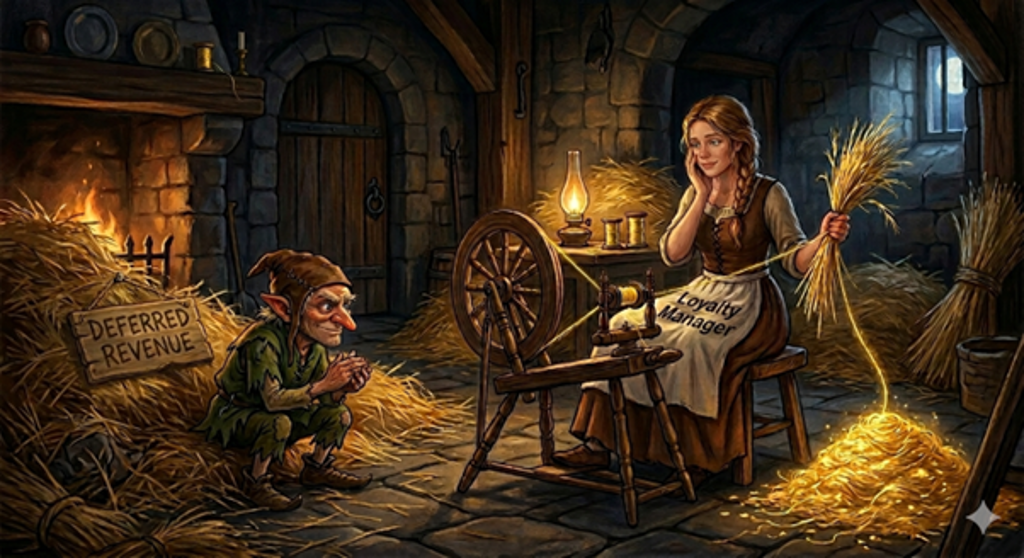
Spinning Straw into Gold, Loyalty Program Liability and Rumpelstiltskin.
For organisations offering their customers loyalty points a liability sits on the balance sheet, money put aside to honour the promise of future rewards. Treated as a cache of ‘dead money’, finance teams track it carefully, loyalty managers are told to “manage it down”, auditors apply advanced actuarial models to make sure not a cent too little is put aside.
The marketer in us thinks this is bleak thinking for many retailers, technically correct but strategically incomplete.
That liability is a pool of money customers have already mentally allocated to your brand and program. Unlike most discretionary spend, you know exactly how large that pool is and who holds it. The challenge is to encourage customers to spend it in ways that also generate incremental margin for you. A second bite of the cherry.
The Situation
The loyalty accounting standards require that when members earn points, a portion of sales revenue is reserved to cover future reward costs. This deferred revenue appears as a liability on the company’s Balance Sheet until the customer claims a reward or the points expire.
If this liability grows to be significant, Finance tugs their collar and insists the loyalty team ‘do something about it’. Most organisations respond predictably:
They look for ways to issue fewer points without destroying the value proposition
They devalue, making rewards cost more points, a change that immediately reduces the liability in exchange for upsetting customers
Change point expiry policies so more points remain unused and are written off
There is a fourth way, because customers behave differently when spending points on rewards.
It is well documented that members frequently spend well above the value of their reward when they redeem. Myer One, for example, has publicly noted that members spend materially more when redeeming their vouchers, with redemption events driving higher basket values and engagement. That pattern is not unique.
One grocery client of ours observed a 30% increase in basket size when customers redeemed a $15 voucher, more than covering the reward cost and adding margin. The redemption event acted as a spending catalyst, not a cost centre.
Ellipsis encourages you to view reward redemption as a trigger for incremental value creation, not the end.
Consider
Points balances are the customers’ personal stored-value wallet. Customers know they have value accumulated and they often earmark it for something “extra” a treat, a luxury, something guilt-free because it does not impact the household budget. The premium chocolates and extra bottle of wine purchased with grocery points is not taking money from the children’s school lunches.
Three incremental sales opportunities to consider.
First, redemption transactions increase (retail) spending. Members rarely walk in, use a $15 voucher and walk out spending only $15. The reward lowers friction and raises basket size and margin.
Second, “burn campaigns” increase engagement and tenure. Targeted campaigns that offer attractive redemption rates on small-to-medium rewards reduce liability while stimulating incremental purchase behaviour, especially for customers who do not typically accumulate points for larger value rewards. Done well, they simultaneously improve P&L and reduce balance sheet exposure.
Third, travel rewards for the points accumulators have a sustained behavioural impact, they have the dual effect of increasing spending leading up to redemption and customers continue to spend more afterwards. The reward becomes a milestone, so you can afford to be generous because the behaviour shift lasts beyond the redemption event.
Spinning liability ‘straw’ into gold
You don’t have to be a mysterious little man from the Brothers Grimm’ Rumpelstiltskin
Loyalty liability is a customer deposit Members have “earned” within your program. It sits waiting to be activated. You know in the data rich environment of loyalty:
The size of each member’s balance
Their purchase history
Their category preferences
Their engagement level
How can we deploy this capital to create incremental profit?
Perhaps:
Subsidise redemptions in high-margin categories
Target burn campaigns to everyday products customers already buy
Use redemption offers (not cash discounts) to increase cross-category penetration
Burn campaigns do not have to be blunt, they can target favoured products or habitual categories, reinforcing behaviour the customers value. When done well, liability is reduced, margin expands and the member feels rewarded.
If redemption is positioned as a celebration, accessible, aspirational, behaviour-shaping you create a virtuous cycle:
Earn → Anticipate → Redeem → Spend More → Re-engage → Earn Again
That loop drives Return on Loyalty®, not just program participation.
Points liability is not something to be feared, it is a pool of money that requires disciplined management, not just defensive minimisation. The organisations that outperform are those that:
Measure incremental spend during redemption
Model post-redemption behavioural uplift
Actively design burn strategies tied to margin
Treat liability as capital to be deployed
Ask regularly: “How do we make that pool of customer capital work harder for us and for them?”
We are Ellipsis, The Loyalty Experts®. We help organisations find, understand, measure, manage and grow customer value, and turn perceived liabilities into strategic advantage.
If you would like to rethink how your loyalty liability is working for you, let’s talk.