Want more investment in your Loyalty Program? Convince the CFO your ROI is real.
Most loyalty programs are measured with lazy statistics: total members, scan-and-tag rates, and the fact that favourite members spend more than non-members. It is comforting. It is wrong. And it is the reason many programs remain either misunderstood or mismanaged.
The bias hiding in plain sight
Customer behaviour is influenced by more than the rewards offered in a loyalty program. For example: preferences, need states, price sensitivity, habits, advertising exposure, store location, and time of year – all also play a role. Those pesky customers are sometimes just not that into our branding. Yet when it comes to loyalty program evaluation, most brands ignore these complexities and settle for a simple chart showing how much more their members spend.
The reality is this: the very customers most likely to enrol in your program are those who already buy frequently, spend more, and like your brand. This is not the program working - it is one of the error factors in valuing your loyalty program’s impact and sales attribution: self-selection bias. Your highest-value customers join early and engage often, while light or disinterested buyers opt out entirely.
Comparing high-value self selectors with non-members, and attributing the difference to the program is not just naïve – it can inflate perceived returns by orders of magnitude.
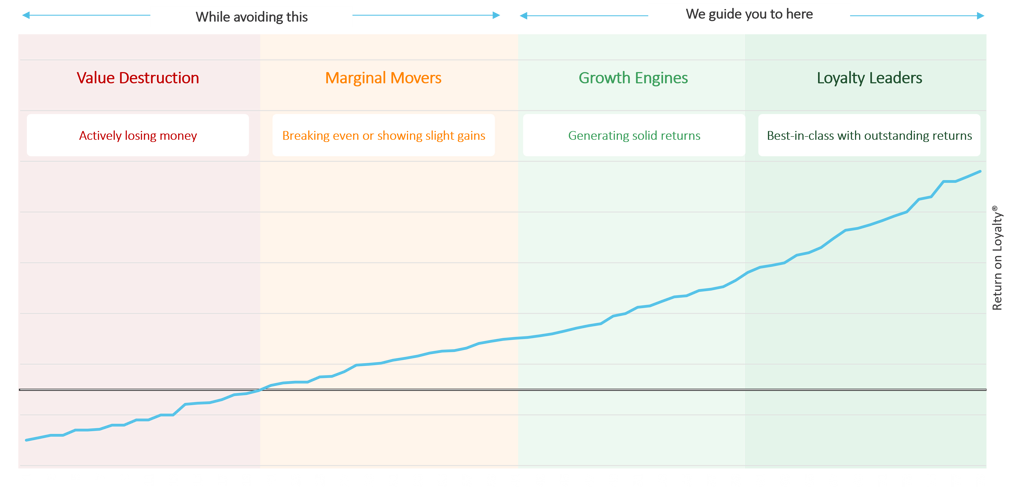
Ellipsis benchmarks from 150+ programs worldwide show that when done right, loyalty has a strong ROI
The difference between loyalty and luck
Academic studies reinforce this view. In one foundational example, Leenheer et al. conducted a detailed analysis of the Dutch grocery market and showed that naïve measurement techniques overstate loyalty effects by approximately 700%. You read that correctly. When customer predispositions are not properly controlled for, supposed program effectiveness skyrockets - unjustifiably.
True causal effects, by contrast, were found to be small but statistically significant - real, measurable, and far more useful for strategic decision-making.
At Ellipsis, we have spent the last two decades refining the mathematics needed to untangle these effects. Not because we enjoy telling clients that their programs are underperforming - but because clarity creates action.
We occasionally ask ourselves over morning coffee: "Are we harming the category by showing the numbers as they really are?" After all, once the comfort of overstatement is removed, will clients still invest?
Our experience says - yes. And with newly established confidence in ongoing measurement, the loyalty program becomes a favoured channel for investment because it can be measured with CFO level rigour and confidence.
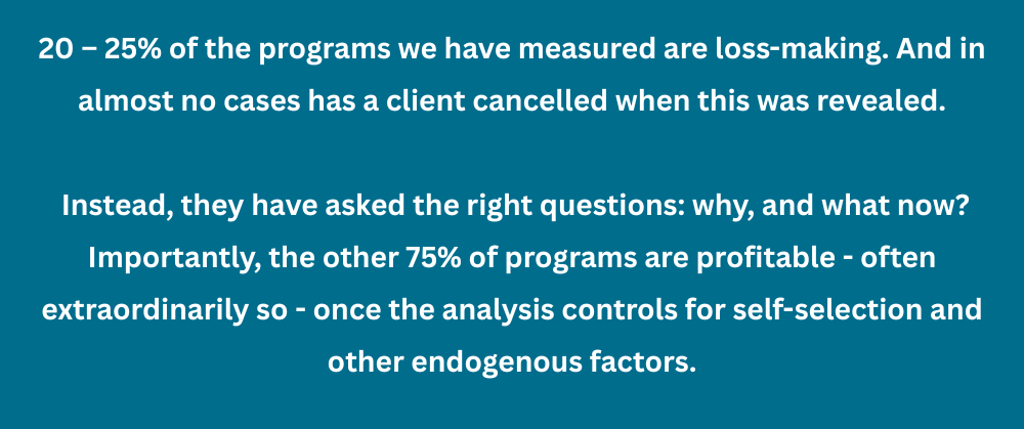
We have been involved in numerous program turnarounds, leveraging insights from rigorous performance measurement. The Ellipsis Knowledge Base includes examples of program changes that delivered significant improvements in engagement because they correctly identified the causes of underperformance. Some example diagnoses:
Poor choice of rewards: Rewards were slow-moving stock, not the best-selling products.
Time to earn: The first reward was too long relative to members’ interpurchase intervals.
Unnoticed rewards: Automatic Cash-back with no minimum threshold meant small reward redemptions were quickly forgotten.
Misaligned Tier thresholds: Set incorrectly, with too many (or too few) members qualifying for each program tier.
High Inter-purchase interval variability: Indicating customers were shopping promiscuously with competitors.
Penetration at extreme levels: The program was holding brand loyalists but not attracting the new customers required to maintain growth.
Simultaneous price and points promotions: Diluting the effectiveness of the loyalty program proposition, confusing customers.
And many other performance inhibitors that, once diagnosed, are straightforward to remove.
Ellipsis Tips – What measurement needs to look like
Fixing broken programs and improving marginal ones starts with better visibility. Loyalty managers must replace vague ROI metrics with attribution frameworks that link investment to incremental value. After decades of doing this work, we know it means:
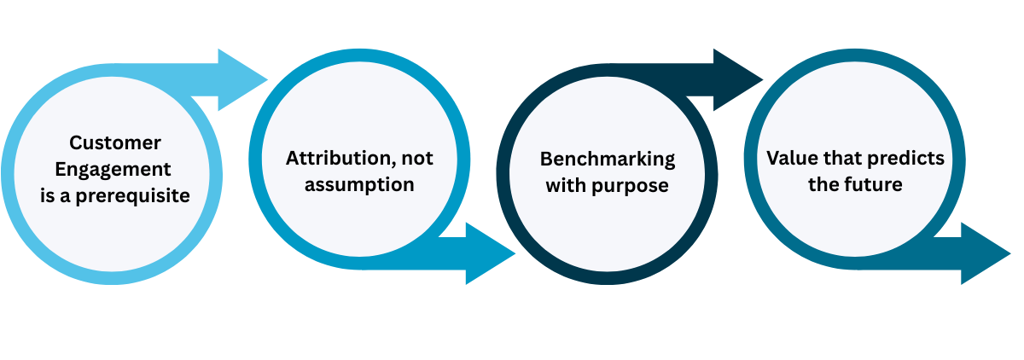
Customer Engagement is a prerequisite: Financial uplift requires members to be active and attentive. Ellipsis Customer Engagement measures this leading indicator.
Attribution, not assumption: Our Loyalty AttributionTM product isolates the impact of program activity on margin uplift.
Benchmarking with purpose: The Expected PerformanceTM data product draws from our knowledge base of over two hundred programs designed and operated, allowing you to identify underperformance early.
Value that predicts the future: Customer Lifetime Value PulseTM gives you a forward-looking view of program impact at the individual member level — supporting smarter investment decisions and lower risk.
 Facts lead to better programs
Loyalty programs are not a leap of faith - or at least, they should not be. When measured correctly, they can powerfully drive profitable growth. However, blissful ignorance has never lifted performance - clarity does.
If your program is helping you sell more, to more customers, more often, and at better margins - you deserve to know exactly how. And if it is not, you need to know what to fix.
Ellipsis is the Loyalty Experts®. If you are unsure whether your program’s results are real or just reassuring, we can help. Contact us to explore how always-on loyalty performance intelligence can drive your next phase of growth.